


Palmistry- Overview
The art of palmistry sometimes referred to as palm reading, chiromancy, or chirology, is the fortune-telling method of using the palm of our hands as a guide.
There are several cultural variations to the practice that are present throughout the world. Chiromancy practitioners are frequently referred to as palmists, hand analysts, hand readers, or chirologists.
The art of palmistry has been practiced in the civilizations of India, Sumeria, Babylonia, Arabia, Canaan, Persia, Nepal, Tibet, and other parts of the Eurasian landmass.
The Sanskrit term for Hindu astrology, Jyotish, Chinese Yijing (also known as the I Ching), and Roma fortune tellers are the earliest sources of palmistry.
A person’s palm can include information about their past, present, and future if all of the indications on the palm are read correctly. This article serves as an introduction to palmistry. This article explains the fundamentals of palmistry, including Hand shapes, lines, and mounts.
Palmistry Tips For Reading Palms
In palmistry the size and shape of your hands, your fingers, hand lines, their lengths, how and where they cross each other, and where they break, or stop are all indicators of your life and personality. We all have a distinct set of fingerprints; thus, they are also essential.
Usually, you’ll look at your non-dominant hand to gain knowledge about your obstacles, intrinsic abilities, and inherited traits. You’ll examine your dominant hand to get a glimpse into your past, your potential for the future, and the decisions you must make.
The two hands together show how you are living up to your potential in this lifetime. Energy practitioners believe that the hands are the heart’s extensions and that they contain the mysteries of the soul.
You should also pay attention to the texture of your hands, including the smoothness or roughness of your palms, the cleanliness or unkemptness of your fingers, and the shape and luster of your nails. The following phase is to become familiar with the various hand lines and shapes.
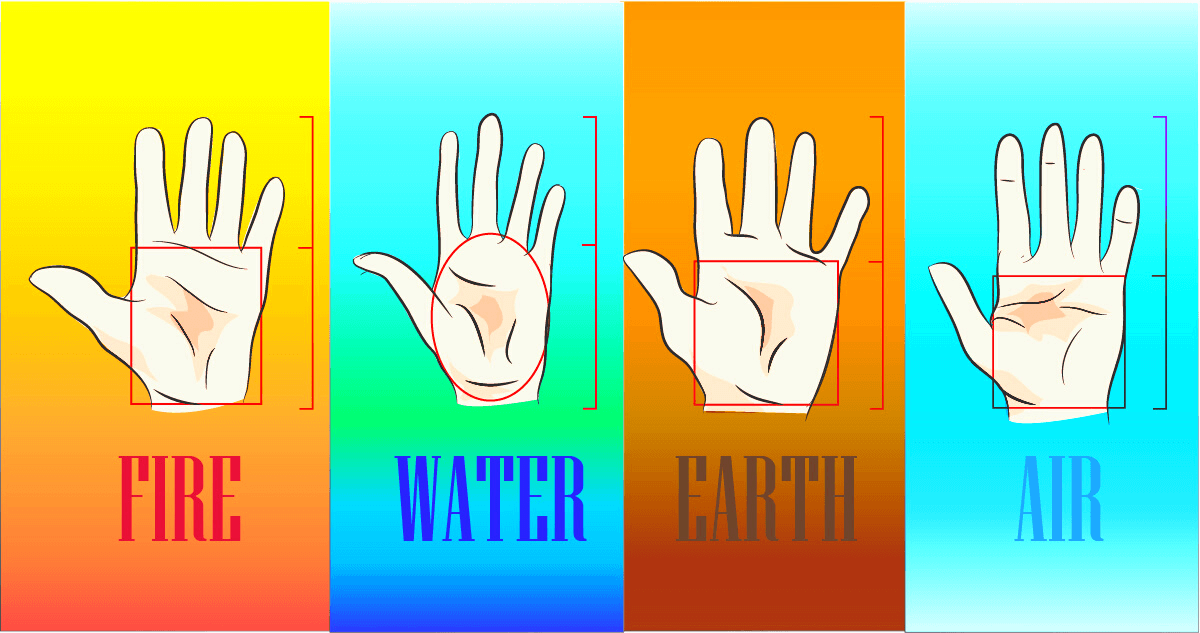
The Hands shape and the Four Element in Palmistry
In palmistry, there are four fundamental hand types, and each one is connected to a certain element and its corresponding characteristics. The shapes of your hands might not match your astrological sign, despite the fact that the four elements are fundamental to astrology.
For instance, if you are a Scorpio, a water sign, but the form of your hand represents the element of air, this signals a shift in your nature.
Earth element hands in palmistry
Earth hands have short fingers and square palms. Frequently, they have a substantial, fleshy feel about them. People with earth hands are sensible, dependable, grounded, and reasonable. They may also be obstinate and fixated on the here and now, which hinders long-term planning and goal setting.
Earth hands in palmistry are typically considered very realistic and level-headed. Instead of learning about it, they would like to go out into the world and experience things for themselves. They are often fairly traditional and enjoy being outside doing things.
Fire element hands in palmistry
Fire element hands in palmistry have short fingers and long palms. People with fire hands are often self-assured, ardent, and dedicated, but because their own interests drive them, they can also lack subtlety and empathy.
These hands could also be a sign of a fiery temper, a high level of energy, and a propensity for spontaneity. Fire hands are frequently fiercely independent and make excellent leaders.
Air element hands in palmistry
Air hands are characterised by their square palms and their long, frequently bony, slim fingers with pronounced knuckles. A witty mind, intelligence, and an outgoing disposition are all traits suggested by air hands.
These people are exceptionally good communicators, intellectually curious, and analytically gifted.
Air types in palmistry are highly intelligent, inquisitive, and creative. They are frequently prone to worry and tension and virtually buzz with anxious energy. Those with Air hands are excellent communicators, but they have a tendency to internalize their emotions excessively. This might cause issues in their deeper relationships.
Water element hands in palmistry
Water hands have lengthy fingers and long palms. They are delicate to the touch and generally quite slender. The palms may feel a little cool. People who have water hands are sensitive, creative, and sympathetic.
They probably have a keen intuition and may even have psychic abilities. Additionally, someone with water hands is likely to be extremely delicate and easily offended.
People who have the Water hand are particularly sensitive. They are incredibly artistic and constantly seeking serenity. Stress can be difficult for Water hands to handle because they are mostly motivated by emotions.

Mounts in Palmistry
After determining your hand type, it’s time to determine which of your palm’s mounts and plains correspond with various life themes. The seven planets are enhanced by the distinctive mounts and their astrological importance.
Mounts with rounded edges and a little rise indicate traits that are proportionate and well-balanced. Extremely noticeable mounts reveal dominant features that may be amplified. Flat mounts are regarded as blind spots that draw attention to a person’s shortcomings.
Mount Of Apollo (Sun) in Palmistry
This region of the hand corresponds with one’s vitality, character, and optimism and is located beneath the ring finger. The Mount of Apollo (sun) stands for contentment, success, and perspective.
A high Sun mount indicates that you are a proud individual who enjoys charming people, and can be lavish, but can also be irritable. A normal Sun mount depicts a person who is versatile, sociable, and self-assured. You may be an uninspired person if you have a low Sun mount and might have a hard time deciding what to do.
Mount Of Jupiter in Palmistry
The Mount of Jupiter is located at the base of the index finger. It stands for aspiration, authority, and conscience. Furthermore, it implies a link to the spiritual world.
A high Jupiter mount indicates that you are extremely egocentric and domineering. If the height of your Jupiter mount is average, you are naturally spiritual, educated, and ambitious. You feel insecure if your Jupiter mount is low or flat.
Mount Of Moon in Palmistry
The region, towards the base of the pinky finger at the base or bottom of the palm speaks to a person’s creativity and generosity. The Mount of Luna/moon stands for creativity, clairvoyance, and psychic abilities.
A high Moon mount denotes a person whose perception of reality has been completely replaced by their imagination. You are incredibly inventive if you have a clearly defined Moon mount (normal) and may have psychic powers, empathy, and a love of the arts.
A person who lives in their thoughts but doesn’t share it with others is said to have a low or flat Moon mount. They can have a tendency to be a bit solitary and downbeat.
Mount of Mercury in Palmistry
The Mount of Mercury, which is located behind the pinky finger, is associated with intelligence, humor, adaptability, communication, and interpersonal abilities. This area reveals one’s inventiveness and strategic thinking.
A person with an abnormally high Mercury mount may speak too much or be deceitful. They are also capable of being greedy.
A typical Mercury mount denotes that you are thoughtful, adaptable, and have a wide range of interests. These folks frequently excel in business and have excellent people skills. Someone with a weak Mercury position is shy, unable to communicate, and possibly not very affluent.
Mount of Saturn in Palmistry
This region, which may be found at the base of the middle finger, is associated with knowledge, responsibility, and tenacity. It highlights a person’s moral character as well as their highs and lows.
A high Saturn mount indicates obstinacy, a propensity for solitude, depression, cynicism, and shyness. If the elevation of your Saturn mount is normal, you are dependable, optimistic, and you have faith in the universe. If it is low or flat, this may indicate that you are shallow and unorganized.
Mount of Venus in Palmistry
At the base of the thumb, you can locate the Mount of Venus. It is connected to love, sexuality, desire, pleasure, and luxury. Innate charisma and a person’s emotional connection to love and romance are highlighted in this region.
A high Venus mount denotes a person who can be excessively lavish and reckless. On occasion, they may develop an obsession with momentary reward.
A person with a balanced, well-developed Venus mount is likely to be powerful and enthusiastic about the art and music. Your interest in domestic life is minimal to nonexistent if your Venus mount is flat.
Inner Mars in Palmistry
The planet Mars is important in palmistry. The three distinct portions stand for temper, adaptability, and aggression. Above the thumb, you will find Inner Mars (also known as Lower Mars). It stands for stamina and physical strength.
If this mount is strong and noticeable, it means you are a very brave, healthy, and adventurous person. You tend to be aggressive if the mount seems overly developed. If it’s low, you can be shy, hesitant, unsure of yourself, and may even lack passion.
Outer Mars in Palmistry
Outer Mars (also known as Upper Mars), which is situated between the Mounts of Mercury and Luna, stands for emotional bravery and persistence.
You are steadfast, persistent, and undaunted if you have a powerful and balanced Outer Mars in your hand. You lack boldness if the outer Mars seems highly developed. Usually, you put up with things that you shouldn’t have to. If it’s flat or too low, it shows that you lack patience and are hasty.
Plane of Mars in Palmistry
The Plane of Mars in palmistry balances the attributes of inner and outer mars and is situated between the Mounts of Inner Mars and Outer Mars in the bottom center of the palm. This is usually a flat area; hence, its significance depends on which lines predominate in the area.

Lines In Palmistry
Future occurrences are dissected using the folds and creases you can see in your palms, known as lines. Each line’s meaning varies depending on its length, depth, and flow. Keep in mind that context is essential while observing hand lines.
Pay special attention to the beginning and end of each line, the mount it crosses, and the point at which the lines merge. When studying palm lines, try to let go a little and trust your instincts.
Head line in Palmistry
This crucial line, which runs down the center of the palm, reveals the life lessons you must master. The head line plays a significant role in determining your destiny and provides a glimpse into your deepest intellectual interests and aspirations.
The depth of the line indicates the complexity of one’s undertakings, whilst the length indicates the scope of those endeavors. Breaks in the line could be a symbol of an important life achievement or of a psychological battle.
A straight line generally favors practicality and structure, while a curved line suggests creativity and spontaneity. A small head line indicates that you value physical success over intellectual achievement.
Heart line in Palmistry
The heart line, also known as the love line, is the highest horizontal line on the palm and is located above the head line. It represents all issues pertaining to the heart, such as relationships, intimacy, and commitment.
Once you’ve located it, decide whether it starts below the index or middle finger, the former highlights your level of relationship satisfaction. The second indicates that you might be bored or restless. While length refers to how long the union has been, is, or will be, depth refers to how significant a partnership is.
If there are breaks, your partners may have been unfaithful, or you may have had many partners. You have a fulfilling romantic life if your heart line begins under your index finger. You are self-centered in your love if it begins below your middle finger. You’re likely to fall in love quickly if it begins between your middle and first fingers.
A small heart line signifies a lack of desire in romance. Your heart breaks quickly if your heart line meets your life line. You convey your emotions with grace and ease if you have a lengthy, curving heart line. You are quite realistic in matters of love if your heart line is straight and parallel to your life line. A wavy heart line denotes multiple relationships.
Life line in Palmistry
The life line is not a joke; it refers to your life journey rather than your impending demise. A thin line actually stands for autonomy and self-determination. The life line in palmistry, which is located beneath the head line, shows your experiences; its depth denotes their abundance.
You have minimal energy and are frequently exhausted if your life line is located very close to your thumb. A broad, curved life line, on the other hand, indicates that you have a lot of energy. You are robust and energized if it swoops in a semicircle. You are cautious in your relationships if it is straight and stays close to the edge of your palm.
While a short and shallow life line indicates you are easily swayed by others, a long and deep life line reveals your inner strength.
Fate line in Palmistry
The fate line, a vertical line in the middle of your palm, reveals how events outside of your control will affect how you live. This line is changeable, which means it is always undergoing change. When you are experiencing a huge change in your life, it is wise to pay attention to it.
The fate line on our hands naturally changes the most over the course of our life. Just so you know, not everyone has a fate line, so don’t feel bad if there is no fate line in your palm.
A significant fate line indicates that destiny has a dominant influence on you. Your life will change a lot as a result of outside influences if your fate line has several breaks.
Sun line in Palmistry
The sun line is a vertical line that runs parallel to the palm’s pinky side. It stands for notoriety, renown, and reputation. It varies in length, depth, and location. You can learn more about your chances of success when combined with your fate line.
If the sun line and fate line cross or are parallel, this is a sign that uncontrollable circumstances may have an impact on your reputation. If these two lines don’t intersect, you may be in charge of navigating your life.
Want to know what the lines in your palm mean? Are you curious to find out more about palmistry mounts and lines on your palm?
Connect with the best Palmist of India on the Guruji app to get a palm reading and to learn more about the fascinating world of palmistry.